Low dose Accutane side effects are the same side effects as full-dose Accutane, just usually less intense. In the studies we have, dry lips still hit nearly everyone at 20 mg a day, but cracking, nosebleeds and joint aches showed up less often than they do at higher doses. Two things don’t shrink with the dose at all: the birth-defect risk, and every iPledge rule that comes with it. This page walks through what gets milder, what stays the same, and what the monthly logistics look like on a longer, gentler course.
If you’re still deciding between the two approaches, our comparison of low dose versus standard isotretinoin covers the dosing math. This page is only about how each day feels once you’re on the medication.
Are low dose Accutane side effects really milder?
Yes, for most of the dryness-type effects, and the research backs that up with real numbers rather than clinic marketing. A 2017 trial hosted by the NIH followed 60 patients for six months, half on 0.25 mg per kilogram per day and half on 0.5 mg per kilogram per day. Every single patient in both groups had dry lips. But the most common complaint in the low-dose group was nose dryness at 17%, while the most common complaint in the conventional group was hair thinning at 33.2%. Acne severity didn’t differ significantly between the groups at any point, and the low-dose patients rated their satisfaction higher, 4.78 versus 4.43 on the study’s scale.
A 2022 meta-analysis pooling dozens of isotretinoin trials found the same direction. Across all doses, dry skin showed up in about 49% of patients, nosebleeds in about 24%, and joint pain in about 17%. When the authors checked whether those rates rose with the dose, they found a positive relationship for dry skin, dry nose, nosebleeds, dry lips and joint pain. Higher dose meant more of each one, and a lower dose meant less. The authors were careful to say the gradient was modest in most cases, so “milder” is the honest word, and “gone” is not.
Your dermatologist picks the dose based on your weight, your skin and your labs. Nothing on this page is a suggestion about what number belongs on your prescription. It’s a map of what tends to happen at the lower end of the range, so the first month doesn’t surprise you.
What side effects did low-dose patients actually report?
The clearest snapshot comes from a 50-patient study on 20 mg a day for three months, published in the Indian Journal of Dermatology and hosted by the NIH. This is the full list the researchers recorded, with the share of patients affected:
- Dry, chapped lips: 98%
- Dry skin: 84%
- Dandruff: 12%
- Facial redness: 8%
- Dry mouth, abnormal cholesterol, or raised liver enzymes: 6% each
- Hair shedding or headache: 4% each
Read that list twice, because it explains the whole low-dose experience. The top two items are close to universal, and everything below them is rare. In that study, 90% of patients cleared more than three quarters of their acne within the three months. That’s the trade: you still get the lip balm life, but the harder stuff mostly stays away.
Compare that with the FDA label for a standard course, which lists dry lips, dry skin, back pain, dry eyes, joint pain and nosebleeds as the most common reactions, with raised triglycerides in about 25% of patients and mild liver enzyme changes in about 15%. Those bigger numbers are the ones our full Accutane side effects guide breaks down line by line. On a low dose, you’re reading the same list with smaller percentages next to each line.
Which side effects don’t get smaller with the dose?
The birth-defect risk doesn’t change at all, and the FDA label says so in plain words: there’s an extremely high risk of life-threatening birth defects if pregnancy occurs while taking any amount of isotretinoin, even for short periods. That single sentence is why iPledge exists and why it applies identically at 10 mg and 80 mg. We’ll get to what that means for your calendar below.
The mental health warning also applies at every dose. The label warns about depression, psychosis and, rarely, suicidal thoughts and behavior, and it doesn’t carve out an exception for smaller capsules. The 2022 meta-analysis found clinically significant depression was no more common on isotretinoin than on other acne treatments, which is reassuring, but the rule for patients is the same everywhere: any mood change gets reported to the prescriber right away, not watched for a few weeks. Our Accutane and mental health page goes deeper on what the evidence does and doesn’t show.
Blood work doesn’t go away either. The American Academy of Dermatology notes your dermatologist checks cholesterol and liver function with a blood test during treatment. In the low-dose study, 6% of patients still showed a lipid or liver enzyme change at 20 mg a day. The number is small, but it isn’t zero, which is why the lab requisition still lands in your inbox on a low dose. Rarer effects the label flags at any dose include decreased night vision and hearing changes, and in some reports those have lasted after treatment ended. They’re rare, but you want to know their names before you start.
What does the dryness actually feel like on a low dose?
Expect the lips first, usually within the first few weeks, followed by tight skin around the nose and mouth. On a low dose it tends to feel like a bad winter rather than a desert. Patients on the forums describe the difference as “I still carry lip balm everywhere” versus “my lips split when I smiled”, and the first one is the low-dose version.
The AAD’s advice for managing it is the same at any dose, and it works better when it starts before the dryness does. Put an oil-free moisturizer on your face while your skin is still damp from washing. Use a lip balm with SPF 30 or higher whenever you’re outside, because isotretinoin makes you sunburn faster. Treat dryness inside your nose as soon as you notice it, since that’s what prevents the nosebleeds. Skip waxing during treatment and for six months after treatment, because the skin can tear and scar.
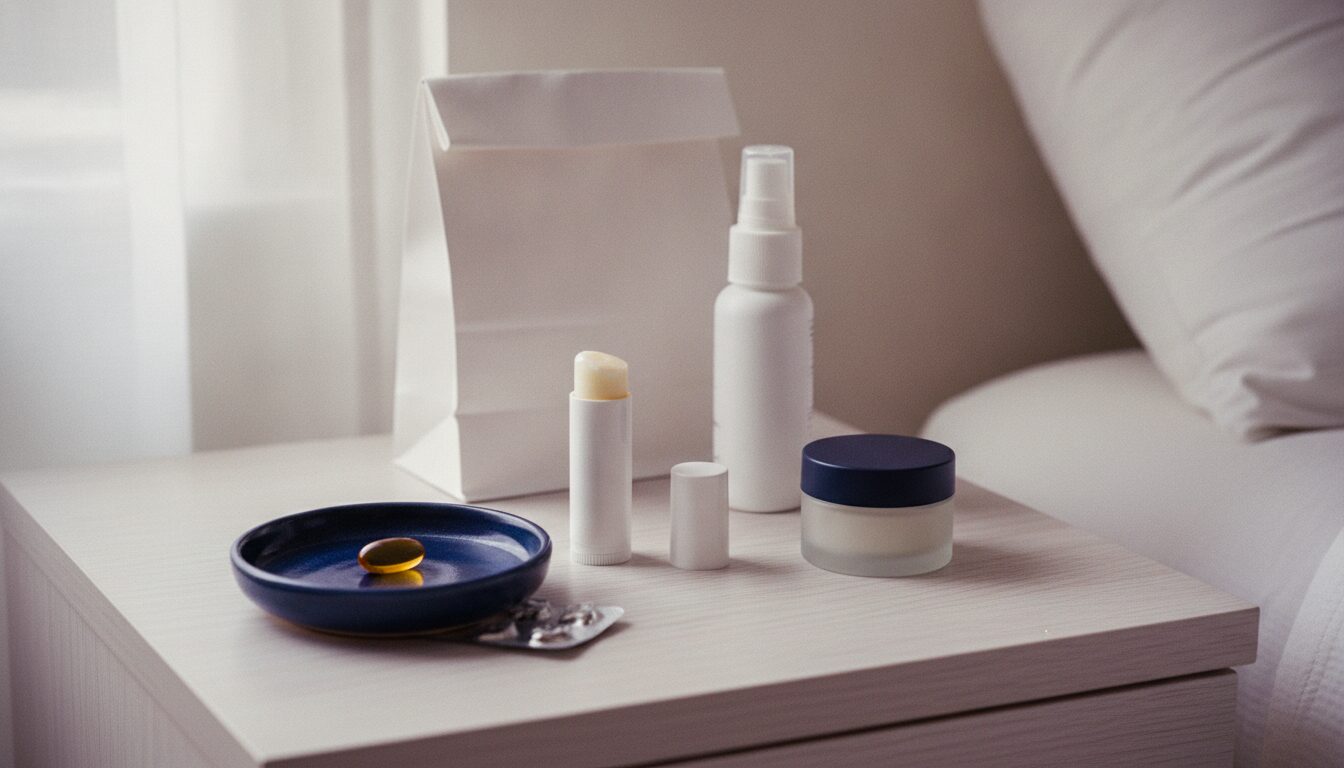
From running the logistics side of this every day, we’ve noticed the month-two mistake is timing, not products. People wait until their lips crack, then order supplies, then spend a rough week waiting for a box. Buy the moisturizer, the SPF lip balm and a saline nasal spray before your first fill, and put them where you’ll see them, so the nightstand is ready before the dryness is. We compared the options in our guide to the best moisturizers for dry skin on Accutane, and our skincare routine while on Accutane page covers which products to retire from your shelf during the course.
One more expectation needs setting before you start: a lower dose usually means a longer course, so the dryness lasts more months even though each month is easier. Our low dose Accutane before and after page maps that timeline month by month.
Does a lower dose mean fewer iPledge rules?

No, and this is the rule that catches low-dose patients most often. Every isotretinoin prescription in the United States runs through the FDA’s iPledge program, and the program doesn’t look at your dose, it looks at the calendar. The rules that apply on every fill, at any dose, come straight from the FDA label and the FDA’s iPledge REMS page.
Each prescription is a maximum 30-day supply. For patients who can become pregnant, a pregnancy test is required before each prescription, and the prescription has to be picked up within a 7-day window that starts the day the test sample is collected. Under the FDA’s current enforcement approach, in place since late 2023, the pregnancy tests before treatment starts must be done in a medical setting such as an office or lab, while prescribers may allow home tests during and after treatment. The FDA approved a set of iPledge changes in February 2026, including removal of the old 19-day lockout after a missed window, but those changes are now scheduled to take effect on November 15, 2026. Until then, the FDA’s own notices say it plainly: if the authorization expires before you pick up the prescription, you go back to the prescriber and start the authorization process again.
Now do the arithmetic for a low-dose course. A gentler daily dose usually stretches the course past the 15 to 20 weeks the label describes for a standard one, and every extra month is another 30-day fill, another window, and another test if that applies to you. More months of milder side effects means more iPledge cycles, not fewer. Our plain-English iPledge program guide covers the whole system if you’re new to it.
These are the dates we watch every day, because these are the dates people actually miss. The program runs two clocks at once, the monthly cycle and the 7-day pickup window, and most first-month surprises come from tracking one and forgetting the other. The pickup window is seven days, and most people learn that the hard way with their first fill. Nothing warns you when a window closes, either. No email arrives, and no text from iPledge. Someone has to be watching the dates, and on a longer low-dose course there are simply more dates to watch. That calendar is the whole job of our Concierge. The prescribing stays with your dermatologist, and the windows stay with us. If you want the exact timing rules, our page on Accutane prescription window timing lays them out day by day.
When should you call the prescriber instead of waiting?
Dry lips and tight skin are expected, and the AAD’s advice above handles them at home. Anything on the FDA’s warning list is different, and the dose doesn’t change that. Call the prescriber the same day for any change in mood or thinking, any trouble seeing at night, hearing changes, severe headache, bad stomach pain, or muscle and joint pain that’s more than a mild ache after exercise. The AAD’s own guidance is to report side effects to your dermatologist right away rather than waiting until the next visit.
The AAD also lists a few things to stop doing before you start, at any dose: no waxing, no blood donation during treatment and for 30 days after treatment, no tanning, and broad-spectrum SPF 30 or higher every day you’re outside. None of that is medical advice from us. It’s the program’s own rulebook, and we repeat it because patients on a “gentle” dose sometimes assume it’s optional, and it isn’t.
Frequently asked questions
Are low dose Accutane side effects easier than full dose?
Usually, yes, for the dryness-type effects. In a six-month NIH-hosted trial comparing 0.25 with 0.5 mg per kilogram per day, both groups had dry lips, but the low-dose group reported fewer other side effects and higher satisfaction. The birth-defect risk and the mental health warning apply equally at every dose.
Does microdosing Accutane have side effects?
Yes, it does, and the 20 mg per day study shows how much: 98% of patients still had dry lips and 84% had dry skin. The rarer effects such as raised cholesterol or liver enzymes showed up in about 6% of patients. “Microdose” is a marketing word, and our microdosing Accutane page explains what it does and doesn’t change.
Do you still need blood tests on low dose Accutane?
Yes, at every dose, because the AAD notes your dermatologist checks cholesterol and liver function with a blood test during treatment, and iPledge pregnancy testing rules apply at every dose for patients who can become pregnant.
Is there a purge on low dose Accutane?
There can be, in the early weeks, and patients generally describe it as milder than on a standard course. The AAD lists a temporary worsening of acne as a possible side effect while noting it doesn’t happen to most patients. Our Accutane purge guide explains why it isn’t a sign the treatment is failing.
Do low dose Accutane side effects go away after you stop?
The dryness effects fade after the course ends for most patients. The FDA label notes that decreased night vision and hearing changes have persisted after treatment in some reports, which is why they’re on the call-the-prescriber list at any dose.
Do the iPledge rules relax on a low dose?
No, not one of them relaxes, because the 30-day supply, the pregnancy test rules and the 7-day pickup window apply identically at every dose, and a longer low-dose course means more of those cycles, not fewer.
The bottom line
Low dose Accutane side effects are real but mostly livable: nearly everyone gets dry lips and dry skin, and the harder effects show up in a small minority. The two things a lower dose never softens are the pregnancy risk and the iPledge calendar that protects against it, and a gentler course means more months of both. Manage the dryness before it starts, report anything on the FDA warning list the same day, and treat the monthly windows as seriously as the capsules.
If the treatment sounds right and the monthly logistics sound exhausting, that second part is our whole job. Start your consult at thegoalisclear.com/quiz whenever you’re ready. A board-certified dermatologist reviews your skin and decides whether isotretinoin belongs in your plan and at what dose, and our Concierge keeps every window on track from the first fill to the last.
Sources
- FDA prescribing information, Absorica (isotretinoin) capsules, via DailyMed (NIH): dailymed.nlm.nih.gov/dailymed/drugInfo.cfm?setid=3ef0cff8-19c1-4441-b780-fca6c7ee1615
- FDA. iPLEDGE Risk Evaluation and Mitigation Strategy (REMS): fda.gov/drugs/postmarket-drug-safety-information-patients-and-providers/ipledge-risk-evaluation-and-mitigation-strategy-rems
- American Academy of Dermatology. Isotretinoin: the truth about side effects: aad.org/public/diseases/acne/derm-treat/isotretinoin/side-effects
- Rao PK, et al. Safety and efficacy of low-dose isotretinoin in the treatment of moderate to severe acne vulgaris. Indian J Dermatol, via PMC (NIH): pmc.ncbi.nlm.nih.gov/articles/PMC4037971
- Faghihi G, et al. Comparing the efficacy of low dose and conventional dose of oral isotretinoin in treatment of moderate and severe acne vulgaris. J Res Pharm Pract 2017, via PMC (NIH): pmc.ncbi.nlm.nih.gov/articles/PMC5787910
- Kapała J, et al. Adverse events in isotretinoin therapy: a single-arm meta-analysis. 2022, via PMC (NIH): pmc.ncbi.nlm.nih.gov/articles/PMC9180136