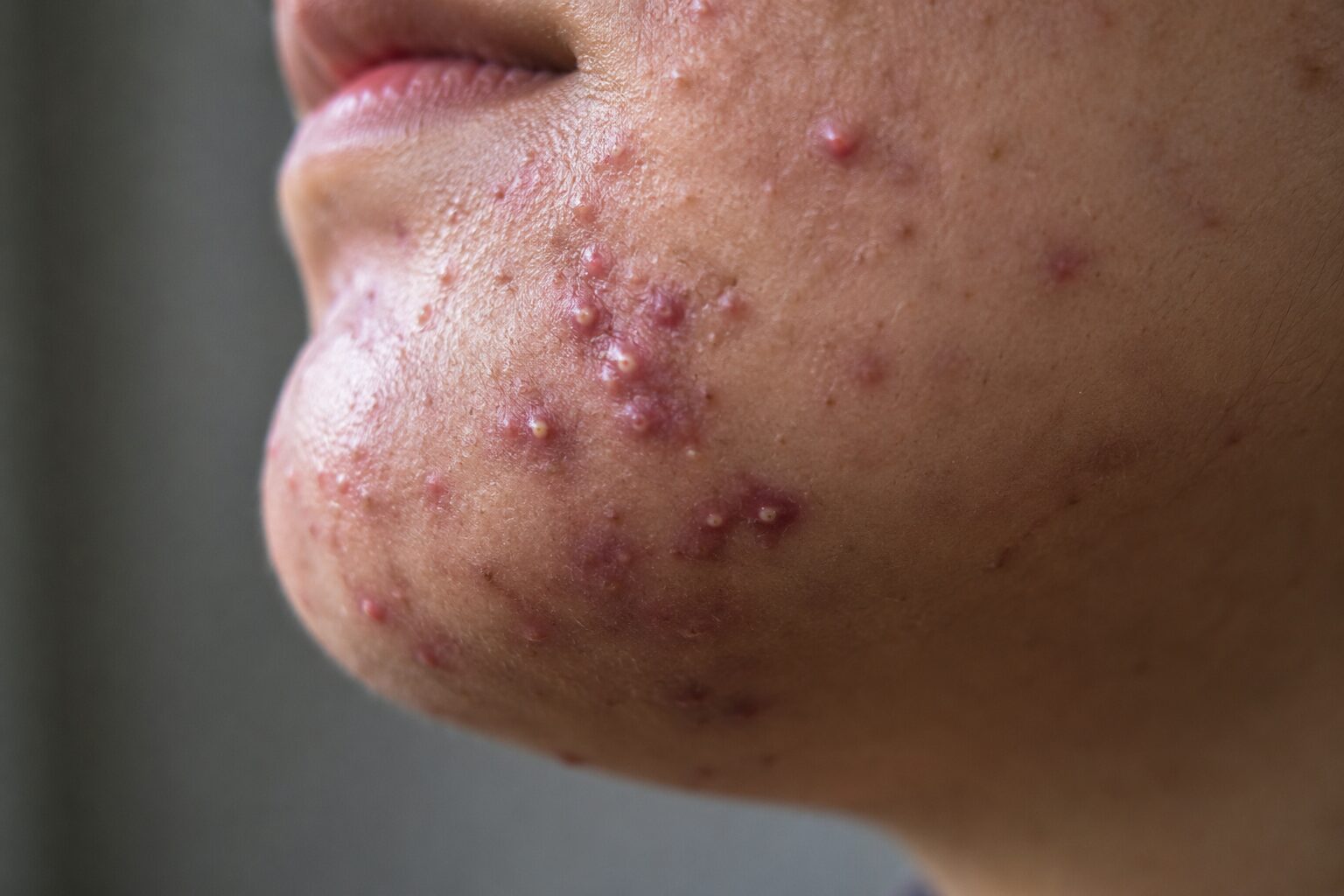
accutane purge explained
Last updated: June 11, 2026
I’ve coached people through some genuinely hard stretches – the week before a big pitch, the month after a business falls apart. But the anxiety I hear from people in their first few weeks on isotretinoin is its own category.
They started a drug their dermatologist told them would clear their skin, and their skin looks worse. That feels like a betrayal.
What I want to do here is walk you through exactly what’s happening, week by week, so you can make sense of what you’re seeing. I’ll cover the biology in plain terms, give you a realistic timeline, and tell you what I’ve actually observed in clients who went through this process.
Nothing here replaces your dermatologist. But understanding the mechanism changes how you experience it. That matters more than most people expect.
Quick answer: The Accutane purge is a temporary worsening of acne that occurs in the first four to eight weeks of isotretinoin treatment. The drug rapidly accelerates skin cell turnover, pushing clogged follicles and microcomedones to the surface simultaneously. The purge typically peaks around weeks two through four, then subsides as isotretinoin begins suppressing sebum production and clearing pores long-term.
What Actually Happens Inside Your Skin During the Purge
The Accutane purge happens because isotretinoin forces two major changes in your skin at the same time – and the combination creates a temporary backlog that has to clear somewhere.
First, the drug dramatically cuts your sebum production. Your sebaceous glands – the oil-producing structures under each pore – can shrink by as much as 90% within the first few weeks. At the same time, isotretinoin speeds up how fast your skin cells turn over and shed.
Your pores have been quietly accumulating trapped oil, dead skin cells, and debris for months – sometimes years. When cell turnover accelerates suddenly, all of that material gets pushed toward the surface at once. BHSkin notes that patients commonly describe this as “it gets worse before it gets better,” and that’s an accurate description of the mechanics.
There’s one more layer to it. According to the Advanced Acne Institute, the cells lining your pores begin to function abnormally during the early weeks of treatment. They produce chemicals that drive extra inflammation – so the breakout you see isn’t just the backlog clearing, it’s also your pore lining mid-transition.
The word “purge” is accurate. Your skin is processing a months-long accumulation in a compressed window of a few weeks. Underneath the surface, the conditions that created your acne are already being dismantled. That’s what you’re actually looking at.
The Purge Timeline: What to Expect Week by Week
Knowing roughly when things peak – and when they turn – makes the hard weeks easier to get through. Board-certified dermatologist Eric Howell describes the Accutane purge as a temporary worsening that some patients experience shortly after starting.
Keep in mind that your starting dose and pre-treatment acne severity both affect your personal timeline. Most patients track close to this sequence.
-
Weeks 1-2: Very little changes. Isotretinoin is still building up in your system. Your skin may look about the same as before you started, or only slightly more congested. Some people notice early dryness or tightness. No major breakout yet – this is normal.
-
Weeks 3-6: Peak purge window. This is the hardest stretch. Pustules increase noticeably, and if you’re prone to cystic acne, deeper inflamed cysts may surface during this period. According to Ada West Dermatology, roughly 10% of patients starting isotretinoin experience a noticeable purge where acne worsens before improving. If you’re in that group, weeks 3-6 are typically when it peaks.
-
Weeks 6-8: The turn begins. Sebum production has dropped significantly by now. The backlog of debris has largely cleared. Most patients notice new breakouts slowing down – existing spots start healing faster than new ones appear. This is the first sign that the drug is doing its job.
-
Month 3 onward: Clearing phase. The majority of patients reach clear or near-clear skin somewhere in this window. Skin texture often improves alongside acne reduction. Chronic inflammation that defined your skin before treatment starts to look like a different era.
-
Past week 10-12 with no improvement: Flag it. If you’re still seeing heavy new breakouts past week 10 or 12, contact your dermatologist. That doesn’t mean something is necessarily wrong – but your prescriber may want to assess your dose or rule out other contributing factors.
Purge vs. Allergic Reaction vs. Persistent Breakout: Telling Them Apart
Most worsening in the first 8 weeks is a normal purge. Two scenarios are different and do require contacting your dermatologist – an allergic reaction and a persistent breakout that signals something else is going on.
I tell every client I work with during this phase to know these distinctions before they need them. Anxiety makes it hard to think clearly at 11pm when your face looks worse than it did before you started treatment. Having the comparison in your head ahead of time removes a lot of that friction.
| Feature | Normal Purge | Allergic Reaction | Persistent Breakout |
|---|---|---|---|
| Location | Same areas as pre-existing acne | Hives, spreading rash anywhere on body | New areas not previously acne-prone |
| Type of lesions | Pustules, papules, deeper cysts | Hives, swelling, blistering | Mix of new and unusual lesion types |
| Timing | Starts weeks 1-6, resolves by week 8 | Can appear any time after starting drug | No meaningful improvement by week 10-12 |
| Systemic symptoms | None | Possible: swelling, breathing difficulty, fever | None typically |
| What to do | Stay the course, keep follow-up appointments | Stop drug immediately, contact doctor or go to ER | Contact dermatologist to discuss dose adjustment |
A normal purge stays in your usual acne zones – jaw, forehead, cheeks, back – and resolves within 8 weeks. An allergic reaction behaves differently: hives, swelling, a spreading rash, or any difficulty breathing means you stop the drug and seek care immediately.
A persistent breakout that shows no sign of improving past week 10-12 is worth a conversation with your prescriber – not a reason to panic, but a signal that your dose or approach may need review.
What I Saw Coaching Clients Through Their First Month on Isotretinoin
The pattern I keep seeing is that the emotional friction of the purge is more dangerous than the purge itself.
Most people who quit early do it because nobody set a specific expectation – not “it might get worse” but “here is the week it will likely peak, here is what it will probably look like, and here is when it will turn.”
That specificity changes everything. Vague warnings don’t hold up under four weeks of worsening skin.
Managing the Purge Without Sabotaging Your Treatment
The most common mistake I see during the purge is adding things. People pile on spot treatments, switch cleansers, try new actives – anything that feels like doing something. For most who experience a purge, it is generally mild and will improve on its own. The job during this phase is to not make it worse.
Here’s what actually works during the purge phase:
-
Keep your skincare to three steps maximum – A gentle, fragrance-free cleanser, a basic moisturizer, and SPF 30+ in the morning. That’s it. Isotretinoin is doing the heavy lifting. Adding retinoids, AHAs, BHAs, or exfoliating acids on top of it overloads already-compromised skin.
-
Do not pick or extract – Skin barrier function is reduced during isotretinoin treatment, and the risk of scarring and post-inflammatory hyperpigmentation is higher than normal. A lesion that might heal cleanly in two weeks can leave a mark that lasts months if you intervene.
-
Stay in contact with your prescribing dermatologist – Do not adjust your dose yourself, and do not stop the drug without talking to your doctor first. Dose decisions during a purge require clinical judgment, not a Google search.
-
Hydration is non-negotiable – Isotretinoin dries your mucous membranes, lips, eyes, and skin simultaneously. A basic unscented moisturizer twice a day and a lip balm with you at all times are practical necessities, not optional extras.
-
Manage the social pressure around you – People in your life will notice your skin looks worse and may push you to stop. This is a real friction point. A short explanation of the timeline – “it peaks around week 4-6 and then clears” – gives people around you a framework and takes some of the pressure off you.
-
Avoid adding antibiotics, harsh spot treatments, or new prescription topicals – Unless your dermatologist specifically recommends it, don’t layer new actives onto your routine. Combination approaches during the purge phase need to be dermatologist-directed, not self-assembled.
For a full picture of how isotretinoin works from start to finish, the isotretinoin treatment guide covers the complete course in detail. You may also find it helpful to review our Accutane side effects overview, isotretinoin dosage guide, and post-Accutane skincare guide as you plan your treatment.
What Patients Actually Ask About the Accutane Purge
Does everyone get the Accutane purge?
No – roughly 10% of patients experience a noticeable purge. Many people start isotretinoin and see a gradual, steady improvement from week one with no dramatic worsening at all. If your skin isn’t getting worse in the first few weeks, that’s not a sign the drug isn’t working.
How long does the Accutane purge last?
For most patients who do purge, it peaks between weeks 3 and 6 and resolves by week 8. If you’re still seeing heavy new breakouts past weeks 10-12, that’s when to call your dermatologist – not to panic, but to check whether a dose adjustment makes sense.
Does a worse purge mean better results in the end?
No reliable evidence supports this. Purge severity does not predict final clearance. Some patients with severe purges and some with no purge at all both achieve clear skin by the end of their course. Don’t read your week 4 skin as a forecast.
Can I use benzoyl peroxide or salicylic acid during the purge?
Most dermatologists advise against it. Your skin barrier is already compromised during isotretinoin treatment, and adding active ingredients like benzoyl peroxide or salicylic acid increases irritation risk significantly. If you’re considering adding anything to your routine, check with your prescribing dermatologist first.
Should I stop Accutane if the purge is severe?
Do not stop without consulting your dermatologist. In some cases a temporary dose reduction is considered when the purge is severe – but stopping abruptly may mean restarting a full course later. The decision belongs to your prescriber, not to the moment of peak anxiety at week 4.
Sources
- Understanding the Accutane Purge – Advanced Acne Institute – pore-lining cell dysfunction and inflammation mechanism
- The Accutane Purge Part 3: What should I expect? – Advanced Acne Institute – purge severity and self-resolution
- Accutane purge: Can you prevent it? – Miiskin – dermatologist Eric Howell on temporary worsening
- Dermatologists explain what to expect from Accutane – Schlessinger MD – clinical overview of isotretinoin purge
- Accutane Myths Busted – Ada West Dermatology – 10% purge incidence statistic
- Accutane Before & After | Accutane Purge, Timeline and Recovery – BHSkin – patient experience and purge cause