
Can You Use Retinol or Tretinoin While on Accutane?
Last updated: June 26, 2026
I’ve talked with a lot of people mid-Accutane course who are still reaching for their tretinoin at night out of habit. It makes sense – tretinoin was probably doing real work for their skin before isotretinoin, and stopping feels like a step backward.
The short version: using both at the same time is a bad idea for most people, and the reason is more specific than “too many actives.” Both drugs work through the same biological pathway, and stacking them doesn’t double your results – it doubles your risk.
This guide covers why the combination is flagged by pharmacists, what the one narrow clinical exception actually looks like, what you should use on your skin instead, and exactly when you can safely bring tretinoin back after your course ends.
Quick answer: You should not use tretinoin while on Accutane. Both are retinoids that work through the same vitamin A pathways, so combining them dramatically increases the risk of severe skin irritation, peeling, and toxicity without added benefit. Most dermatologists recommend waiting at least six months after finishing Accutane before reintroducing topical tretinoin.
The Short Answer: No – and Here’s the Pharmacological Reason
You should not use tretinoin or retinol while on a standard Accutane course. Accutane (isotretinoin) is itself a retinoid – a direct derivative of vitamin A – and it works systemically, meaning it affects your entire body, not just the spot you apply something to.
Tretinoin is also a retinoid. So is retinol, which your skin enzymes convert into retinoic acid after you apply it. If you want to understand how those two compare before your Accutane course, retinol vs tretinoin for acne – how they differ and which you need breaks that down clearly.
When isotretinoin is already circulating in your system at therapeutic levels, it has essentially saturated your retinoid receptors. Adding topical tretinoin on top of that doesn’t push things further in a useful direction – it just increases the total vitamin A load.
Drugs.com flags this combination as “generally not recommended” due to hypervitaminosis A risk, and GoodRx lists tretinoin and adapalene explicitly among the Accutane interactions to avoid.
Hypervitaminosis A means your body is carrying more vitamin A activity than it can safely handle. The symptoms aren’t subtle – think severe peeling, relentless dryness, headaches, and in serious cases, liver stress. Accutane already pushes your body close to that threshold by design. Tretinoin is not a harmless topical add-on in this context.
Why Combining Retinoids Is Riskier Than It Sounds
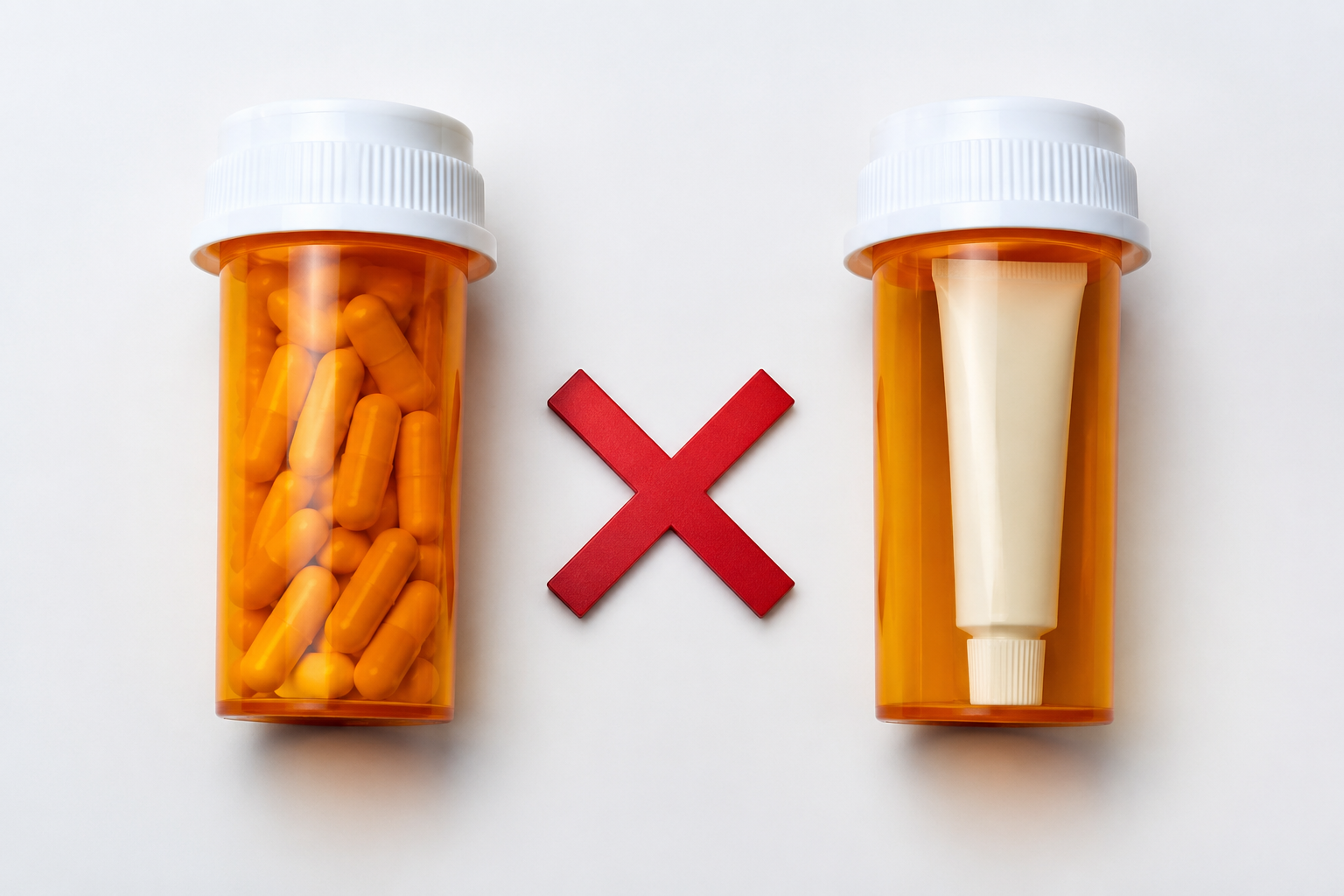
The risks here go beyond “your face will peel a lot.” Here is what is actually happening under the surface.
-
Hypervitaminosis A symptoms compound fast – Isotretinoin already raises your systemic vitamin A load to near-therapeutic limits; adding any retinoid on top – even topically – can push you into symptoms like severe headaches, nausea, increased liver enzyme levels, and skin that cracks rather than just flakes.
-
Your skin barrier is already compromised on Accutane – Isotretinoin suppresses sebaceous gland output by up to 90%, which strips your skin of its natural lipid layer. Applying a retinoid to a barrier that damaged accelerates irritation, redness, and peeling far beyond what either drug causes alone.
-
Topical tretinoin does enter your bloodstream – Absorption is low, but it is not zero. Some fraction of what you apply crosses the skin and adds to circulating retinoid levels. That small addition matters when your baseline is already elevated.
-
Accutane thins the skin and raises UV sensitivity – A dermatologist on RealSelf notes that tretinoin’s exfoliating action on already-fragile Accutane skin is a specific concern – the skin simply cannot tolerate that level of cell turnover disruption. Photodamage risk goes up alongside it.
-
The exfoliation overlap serves no purpose – Tretinoin’s main jobs are accelerating cell turnover and stimulating collagen. Isotretinoin is already reshaping how your skin cells behave at a systemic level. You are not getting a texture bonus from adding tretinoin – you are just getting more inflammation.
-
Retinoid-related side effects become harder to manage – When you are on Accutane alone, your dermatologist can adjust your dose if side effects get severe. If you add tretinoin without telling them, the picture gets muddy fast. Tracking what is causing what becomes nearly impossible.
I stopped recommending any retinoid “just to maintain results” during Accutane the moment I understood how the receptor saturation works. There is nothing to maintain – isotretinoin is already doing the work at a deeper level than tretinoin ever could topically.
The Rare Exception: Low-Dose Isotretinoin + Topical Tretinoin Under Supervision
What to Use on Your Skin While on Accutane Instead
Your only real skincare goal during an Accutane course is barrier repair and hydration. Accutane is doing the heavy lifting on acne – your topicals are not going to meaningfully accelerate that process, and most actives will just add irritation.
Here is how common ingredients stack up as substitutes for what retinol and tretinoin usually provide:
| Ingredient | What It Replaces | Safe on Accutane? | Notes |
|---|---|---|---|
| Niacinamide (4-10%) | Pore appearance, texture | Yes | Anti-inflammatory, calms redness; well-tolerated even on sensitive skin |
| Azelaic acid (10% OTC) | Tone, mild exfoliation | Use with caution | Lower concentrations (10%) are gentler; avoid 20% prescription strength mid-course |
| Lactic acid (5% max) | Gentle cell turnover | Use with caution | Patch test first; skip if skin is actively peeling or broken |
| Hyaluronic acid | Hydration | Yes | Apply to damp skin to maximize moisture binding |
| Mineral SPF 30+ | UV protection | Yes – essential | Accutane raises photosensitivity significantly; this is non-negotiable daily |
| Ceramide moisturizer | Barrier repair | Yes – priority | CeraVe or La Roche-Posay Cicaplast are common go-tos; apply morning and night |
Do not use retinol, tretinoin, adapalene, or benzoyl peroxide at concentrations above 2.5% during your course. If you want to explore what the best over-the-counter retinol for acne looks like post-Accutane, that is a useful reference for when your course ends – but not before.
Accutane is already transforming your skin at the level of sebaceous glands and cell differentiation. Topical actives are largely redundant while it’s working. Keep the routine simple – cleanser, ceramide moisturizer, mineral SPF in the morning, and ceramide again at night.
When Can You Restart Tretinoin After Finishing Accutane?
The standard guidance from dermatologists is to wait at least 6 months after finishing Accutane before starting tretinoin. Your skin barrier needs that time to normalize, sebaceous gland function needs to partially recover, and your systemic retinoid load needs to fully clear. Here is how to reintroduce it without triggering a reaction.
-
Confirm your course is fully complete and your derm has cleared you – Do not start tretinoin early because your skin feels fine at week 4 post-Accutane. The surface can look normal while the barrier is still compromised underneath. Get an explicit green light from your prescriber before adding any retinoid back in.
-
Track your dryness and sensitivity for 4-8 weeks post-course – Watch for three specific signals that your barrier is recovering: reduced baseline flakiness, less tightness after washing, and improved tolerance to your regular moisturizer without needing constant reapplication. When those stabilize, you are getting closer.
-
Start with 0.025% tretinoin every third night – This is the lowest available concentration, and every third night gives your skin 48 hours to recover between applications. I have seen people jump straight to 0.05% after Accutane and spend 6 weeks dealing with unnecessary peeling when starting lower would have gotten them to the same place by week 10 with far less irritation.
-
Increase frequency slowly over 8-12 weeks – Move from every third night to every other night only after 4 weeks of no significant redness or peeling. Then move to nightly only after another 4 weeks. For tretinoin before and after results and timelines, the visible payoff typically starts around the 12-week mark when introduced this carefully.
-
Add tretinoin before anything else – Do not layer in AHAs, vitamin C, or other actives until you are tolerating nightly tretinoin well. Some people experience a retinol purge: why skin gets worse before it gets better even post-Accutane – knowing that is normal prevents you from stopping too early.
What Accutane Users Actually Ask About Retinoids
Can I use retinol instead of tretinoin while on Accutane – is it safer?
No. Retinol converts to retinoic acid inside your skin through a two-step enzymatic process, which makes it functionally a retinoid with the same mechanism as tretinoin – just slower and weaker. The stacking risk with isotretinoin still applies. Retinol is not a safe workaround; it is the same category of ingredient at a lower potency. Avoid both during your course.
What happens if I accidentally used tretinoin once while on Accutane?
One accidental application is unlikely to cause serious harm, but you may see significant irritation, redness, and peeling over the next 24-48 hours. Stop immediately, apply a fragrance-free ceramide moisturizer, and skip any other actives for several days.
Tell your dermatologist at your next visit – they need to know so they can monitor for any unusual reactions and adjust your Accutane dose if warranted.
Does Accutane make tretinoin unnecessary afterward?
Not permanently. Accutane targets sebaceous glands and can produce long-term or even permanent remission in about 85% of patients after a full course, but it does not permanently restructure your skin’s collagen or texture.
Tretinoin post-Accutane is often used for anti-aging, scar fading, and long-term maintenance. You may also want to compare retinol vs tretinoin: which one actually works better when deciding how to approach maintenance after your course.
Can I use adapalene (Differin) while on Accutane?
No. Adapalene is a third-generation retinoid and carries the exact same interaction risk as tretinoin. GoodRx explicitly lists adapalene alongside tretinoin as an Accutane interaction to avoid. The fact that adapalene is available over the counter does not make it safer to combine with isotretinoin – it is still a retinoid acting on the same receptors.
Sources
The sources below are the primary references I used throughout this article. If your dermatologist gives you different guidance, trust their clinical judgment over anything you read online – but these are solid starting points for understanding the pharmacology.
- Drugs.com – Accutane + Tretinoin drug interaction
- GoodRx – 7 Accutane Interactions to Avoid
- PubMed PMID 16281880 – Low-dose isotretinoin combined with tretinoin clinical study
- RealSelf – Dermatologist Q&A on tretinoin during Accutane
- American Academy of Dermatology – Isotretinoin patient information
- NIH MedlinePlus – Isotretinoin drug information