
Accutane vs Tretinoin: Oral vs Topical – Which Do You Need?
Last updated: June 26, 2026
I’ve spent years watching patients come in frustrated – they’ve burned through every OTC product on the shelf and finally want a real answer. The question I hear most often is some version of: “Should I ask for Accutane, or is tretinoin enough?”
These two drugs both come from vitamin A. That’s where the similarity ends. One is a cream you rub on at night; the other is a pill that rewires how your skin makes oil. Choosing between them isn’t about which sounds more intense – it’s about matching the drug to what’s actually driving your breakouts.
This article breaks down how each one works, who each one is actually right for, and what you’ll realistically go through on either path. I’ll include my own experience moving from one to the other, so you can see what that journey looks like in practice.
Quick answer: Accutane is an oral medication for severe or cystic acne, while tretinoin is a topical retinoid used for mild-to-moderate acne and anti-aging. Acne severity — not personal preference — determines which is appropriate. Tretinoin is the standard first step; Accutane is reserved for cases that fail topical treatments due to its serious systemic side effects.
Side by Side: How Accutane and Tretinoin Actually Work
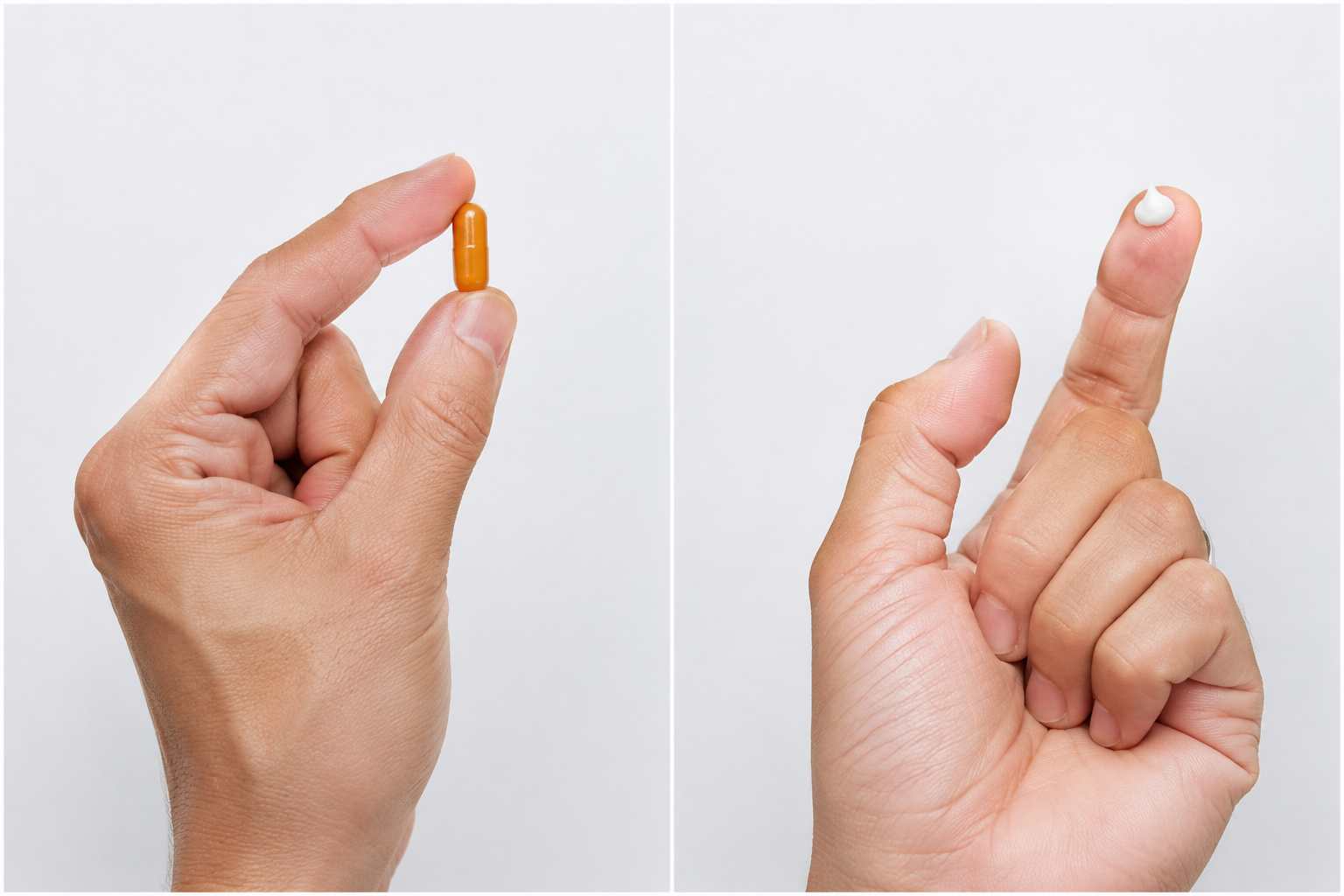
These are two distinct drugs with different mechanisms, delivery routes, and risk profiles. As Verywell Health explains, tretinoin is a topical cream for mild-to-moderate acne, while isotretinoin is an oral medication reserved for severe nodular cases. Understanding that gap is the foundation of every other decision in this article.
For a broader look at where these drugs fit among all your prescription options, see our acne treatment comparison guide.
| Tretinoin | Isotretinoin (Accutane) | |
|---|---|---|
| Drug class | Topical retinoid (retinoic acid) | Oral retinoid (vitamin A derivative) |
| How it’s delivered | Applied directly to skin | Taken by mouth; works through the bloodstream |
| Primary mechanism | Speeds up skin cell turnover; unclogs pores and prevents new comedones | Shrinks sebaceous (oil) glands by up to 90%; suppresses sebum production across your entire face and body |
| Acne pathways targeted | 2 of 4 (comedone formation, cell turnover) | All 4 (excess oil, clogged pores, bacterial growth, inflammation) |
| Prescription required? | Yes | Yes |
| iPLEDGE enrollment | No | Yes – mandatory federal program due to severe birth defect risk |
| Typical treatment duration | 3-6 months to see results; often used long-term for maintenance | 16-20 weeks; many patients achieve lasting clearance after one course |
| Best suited for | Mild-to-moderate comedonal or inflammatory acne | Severe, nodular, or cystic acne that hasn’t responded to other treatments |
Tretinoin keeps pores clear over time but doesn’t touch the oil glands driving deep, cystic breakouts. If you’re getting painful nodules that leave marks, the table above tells you why a topical cream alone won’t solve it – you need a drug that works from the inside out.
Severity Is the Deciding Factor – Not Preference

Your acne severity – not how badly you want clear skin – is what determines which drug your dermatologist can responsibly prescribe. GoodRx notes that isotretinoin is reserved for severe nodular acne, while tretinoin handles mild-to-moderate cases. Knowing where you fall on that spectrum before your appointment will make the conversation sharper.
Here’s how dermatologists typically think about candidacy:
- Mild-to-moderate comedonal or papulopustular acne – Tretinoin is the standard first prescription step. Whiteheads, blackheads, and small red bumps respond well to the cell-turnover effect.
- Moderate acne with surface inflammation – Tretinoin combined with a topical antibiotic or benzoyl peroxide is often enough. Your dermatologist may also consider how dermatologists choose between oral antibiotics and retinoids before escalating.
- Severe nodular or cystic acne – Isotretinoin is the standard of care here, per the American Academy of Dermatology. Deep nodules and cysts don’t respond reliably to topical-only treatment.
- Moderate acne that has failed two antibiotic courses – This is a common trigger for the isotretinoin conversation. Antibiotic resistance is real, and cycling through a third course rarely changes outcomes.
- Acne causing scarring or significant psychological distress – Scarring risk alone can move a patient into isotretinoin candidacy even if the acne isn’t technically “severe” by lesion count.
- Middle-ground cases – Oral antibiotic options like doxycycline for moderate acne or spironolactone (for hormonal acne in women) often bridge the gap between tretinoin and isotretinoin. I’ve seen patients do 3 months of doxycycline plus tretinoin and avoid isotretinoin entirely.
- Patient preference alone – Wanting Accutane faster isn’t a qualifying criterion. Isotretinoin carries real risks, and most dermatologists require documented treatment failure before prescribing it.
The practical takeaway: show up to your appointment with a timeline. How long have you been breaking out? What have you tried and for how long? Two failed antibiotic courses documented over 6+ months is a much stronger case than “I’ve tried a lot of things.”
Risks You Should Weigh Before Choosing Either
Both drugs carry real trade-offs. A clinical comparison published on PubMed found that low-dose oral isotretinoin and topical tretinoin both show benefit in appropriate candidates – but the risk profiles are very different. I always walk through these before a patient commits to either path.
Tretinoin – Pros
- Works well for mild-to-moderate acne with consistent use
- Also improves fine lines and uneven skin tone over time
- Widely available via telehealth platforms – no monthly office visits required
- Lower overall risk profile compared to systemic medications
- Can be used long-term as a maintenance therapy
Tretinoin – Cons
- Retinization period: expect peeling, redness, and a purge (weeks 2-6 are rough)
- Significant photosensitivity – daily SPF 30+ is non-negotiable, not optional
- Not safe during pregnancy – category X, same as isotretinoin
- Requires ongoing use to maintain results; stopping means acne often returns
- Does nothing for cystic or nodular acne driven by excess sebum production
Isotretinoin – Pros
- Targets all four pathways of acne formation simultaneously
- One 16-20 week course can produce lasting or permanent remission for many patients
- Shrinks sebaceous glands by up to 90%, cutting oil production at the source
- Reduces scarring risk by clearing severe acne faster than any topical can
Isotretinoin – Cons
- Severe teratogenicity – causes major birth defects; the FDA’s iPLEDGE program requires two forms of contraception and monthly pregnancy tests
- Mucocutaneous dryness is nearly universal – cracked lips, dry eyes, and nosebleeds are common at 40mg/day
- Monthly blood work to monitor liver enzymes, cholesterol, and triglycerides throughout the course
- Possible mood changes – discuss any personal or family history of depression with your dermatologist before starting
- Requires in-person monitoring; telehealth-only prescribing is not permitted under iPLEDGE
Anyone who is pregnant, planning to become pregnant, or has certain liver conditions cannot take isotretinoin – full stop. If you fall into any of those categories, tretinoin or doxycycline vs minocycline for acne are the conversations to have instead.
My 6-Month Experiment: Tretinoin First, Then Accutane
Real Questions People Ask Before Choosing
Can I use tretinoin while taking Accutane?
No – combining them dramatically increases dryness and irritation with no added benefit. Isotretinoin already accelerates skin cell turnover systemically; stacking a topical retinoid on top of that pushes most people into severe peeling and sensitivity. Dermatologists don’t prescribe them together, and doing so on your own could damage your skin barrier significantly.
Is tretinoin just a weaker version of Accutane?
They are different molecules that work through different mechanisms – “weaker” misframes the comparison entirely. Tretinoin is retinoic acid applied topically; isotretinoin is an oral pro-drug that your body converts systemically and that acts on your oil glands directly.
They don’t treat the same severity level, so comparing their “strength” is a bit like comparing a topical antibiotic cream to a course of oral antibiotics – related concept, completely different application.
Will tretinoin eventually clear severe cystic acne if I’m patient enough?
Unlikely for true cystic or nodular acne. Tretinoin cannot shrink sebaceous glands or suppress systemic sebum production – those are the two drivers behind deep cysts. Waiting longer on tretinoin when you have active nodular acne risks additional scarring while the underlying cause goes untreated.
If you’ve been on tretinoin for 4+ months and still getting cysts, that’s the conversation to have with your dermatologist.
Can I switch from Accutane to tretinoin for maintenance after my course?
Yes, and many dermatologists recommend exactly that. Tretinoin is a strong maintenance option after isotretinoin – it keeps residual comedones in check and sustains the skin texture improvements from your course. Most dermatologists wait at least 6 months after finishing isotretinoin before introducing tretinoin, since your skin remains sensitive during that window.
Sources
- Verywell Health – Tretinoin vs. Isotretinoin: Benefits and Side Effects
- GoodRx – Isotretinoin vs. Tretinoin for Acne
- PubMed/NCBI – Comparison of topical tretinoin and low-dose oral isotretinoin in severe skin conditions
- American Academy of Dermatology – Isotretinoin: overview and patient guidance
- FDA – iPLEDGE program information for isotretinoin