Tretinoin Before and After: Honest Results and Timelines
Last updated: June 26, 2026
I’ve talked to a lot of people who quit tretinoin at week 5 because their skin looked worse than when they started. That’s the most common mistake I see, and it’s almost always based on wrong expectations set by Instagram highlight reels and Reddit transformation posts.
This article covers what tretinoin actually does, month by month, with real timelines and the variables that shape your results.
If you’re not sure whether tretinoin is the right move or whether retinol vs tretinoin for acne – and which one your skin actually needs applies to your situation, that pillar piece is a good starting point.
What follows here is the honest breakdown of what happens after you fill the prescription.
If you’re not yet prescribed and want something to use in the meantime, the best over-the-counter retinol for acne if you can’t get a prescription is worth reading while you wait for a dermatology appointment.
Quick answer: Tretinoin visibly reduces acne and improves skin texture, but results take time. Most users experience an initial purge in weeks one through four, with noticeable clearing by month three. Significant before-and-after results — fewer breakouts, smoother skin, and faded post-acne marks — typically appear between months four and six of consistent use.
Why Tretinoin Results Look Different for Everyone
The before-and-afters flooding social media are real, but they’re not average. People post when their results are dramatic. The person who saw modest improvement after six months of consistent use rarely makes a video about it – which skews your sense of what tretinoin typically does.
Here are the variables that actually shape your outcome:
- Baseline acne severity – Tretinoin tends to produce the most visible transformations in people with moderate comedonal acne (blackheads, whiteheads, small clogged pores). Severe cystic acne usually needs a systemic medication alongside it to see meaningful clearing.
- Concentration prescribed – The three most common strengths are 0.025%, 0.05%, and 0.1%. Starting at 0.025% is gentler and reduces early irritation, but it may take longer to produce results than 0.05% or 0.1%. Your dermatologist’s starting point reflects your skin’s tolerance, not a ceiling.
- Consistency of use – Nightly application, even a pea-sized amount, compounds over time. Intermittent use – a few nights a week when you remember – slows results significantly. I tracked my own application on a simple calendar app and found I was hitting about 4 nights a week when I thought I was being consistent.
- Age and cell turnover rate – Younger skin turns over faster, which can mean a more intense purge but also faster visible improvement. Skin in your late 30s and 40s turns over more slowly, so results may take a few extra weeks to surface.
- Combination treatments – Tretinoin paired with doxycycline (an oral antibiotic) or spironolactone (a hormonal blocker) consistently outperforms tretinoin alone for inflammatory and hormonal acne. If your dermatologist prescribed one of these alongside tretinoin, that combination is doing more work than either medication would solo.
- Skin type – Oilier skin tends to tolerate tretinoin better early on and may see faster clearing. Dry or sensitive skin often needs a longer buffer period – applying moisturizer first, then tretinoin – before results become apparent without constant irritation.
- Reddit and Instagram bias – Transformation posts self-select for dramatic outcomes. Lighting, angles, and timing all influence the visual impact of a before-and-after photo in ways that have nothing to do with the medication.
The Tretinoin Purge: What’s Actually Happening Under Your Skin
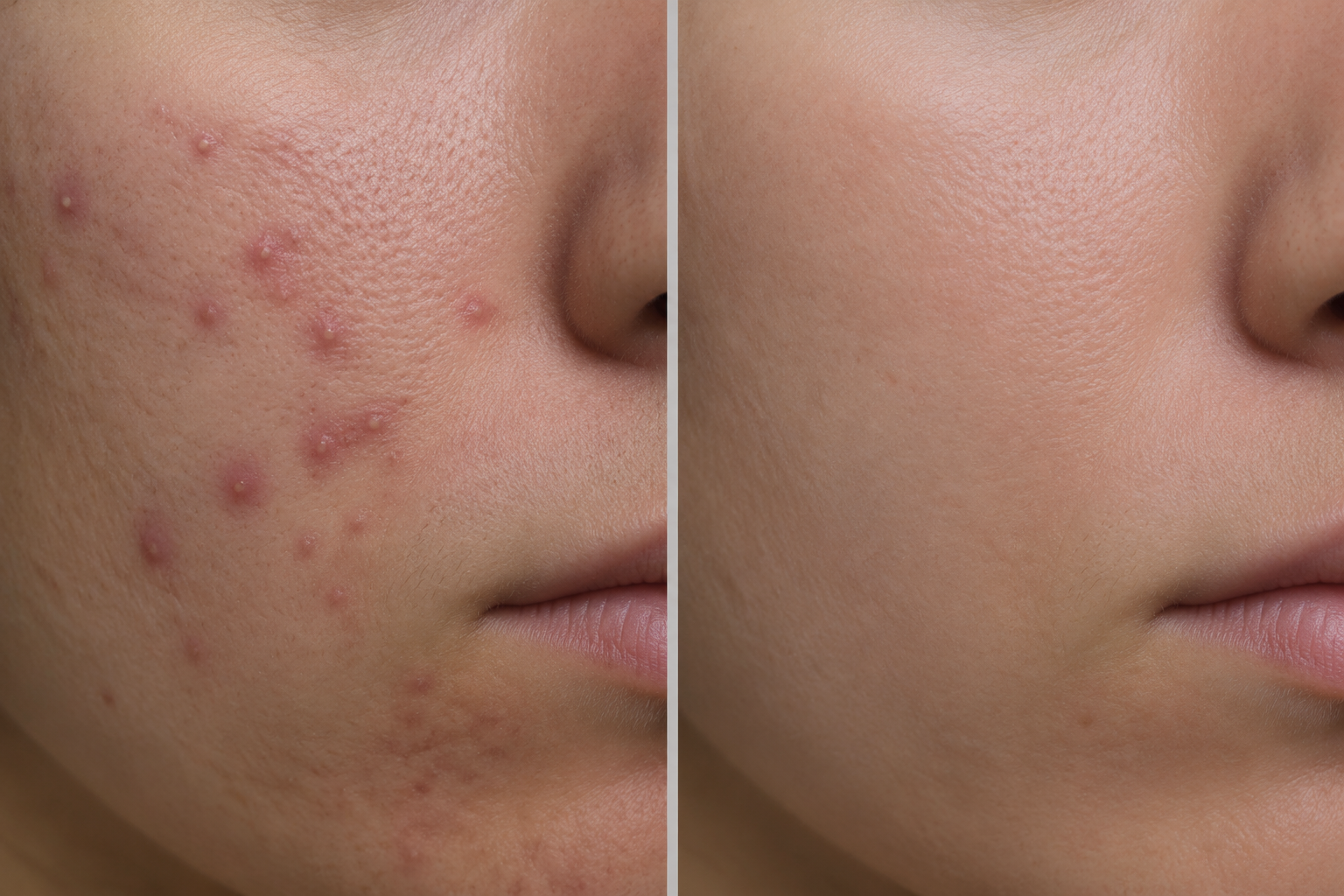
Tretinoin speeds up your skin’s cell turnover rate – sometimes dramatically. Pores that were quietly clogged for weeks get pushed to the surface all at once, which means breakouts that were forming deep in your follicles suddenly become visible. You didn’t cause new acne; you accelerated acne that was already there.
Most people start noticing the purge around weeks 2-6, and it tends to peak somewhere between weeks 4 and 8. The Mayo Clinic acknowledges this directly: acne can appear to get worse before it gets better when starting tretinoin. That window is uncomfortable, but it’s also a sign the medication is working.
The key question is whether what you’re seeing is a purge or a reaction. A purge shows up in the same spots where you normally break out – your chin, jawline, forehead, wherever your acne usually lives. A true reaction looks different: new breakouts in areas you’ve never had acne, hives, or severe redness and peeling beyond mild flaking.
If it’s a purge, the right move is to stay the course. Don’t layer on benzoyl peroxide, salicylic acid, or any other active ingredient to try to fight it faster – that combination will likely cause more irritation than improvement.
A plain, fragrance-free moisturizer like CeraVe Moisturizing Cream applied before or after tretinoin can take the edge off the dryness without interfering with the treatment.
If you’re comparing this to an over-the-counter retinol and wondering whether the purge is similar, the short answer is yes, but usually milder – see what the retinol purge looks like compared to tretinoin for a side-by-side of what to expect at each strength.
Month-by-Month: A Realistic Tretinoin Results Timeline
Clinical studies on tretinoin for acne typically measure endpoints at 12-16 weeks – which tells you something. Meaningful results take time. The table below reflects what most consistent users experience, though your timeline will shift depending on the variables covered above.
I find this breakdown useful for setting a weekly check-in against your own progress rather than comparing yourself to someone’s 30-day transformation post.
| Time Period | What’s Happening | What You’ll Likely See |
|---|---|---|
| Weeks 1-2 | Skin adjusting to accelerated turnover | Dryness, flaking, possible mild redness |
| Weeks 3-6 | Purge phase – clogged follicles surfacing | Increased breakouts, especially in usual acne zones |
| Months 2-3 | Purge subsides, turnover stabilizing | First hints of improvement, fewer new pimples |
| Months 3-6 | Active acne reducing, texture changing | Noticeable acne reduction, skin feels smoother |
| Months 6-12 | Significant clearing, PIH fading | Post-inflammatory dark spots lightening, skin tone evening |
| 12+ months | Maintenance phase | Continued clarity, early anti-aging benefits visible |
Clinical trials typically run 12-16 weeks for acne endpoints, and a PMC review on topical tretinoin confirms consistent efficacy data across that window. But many of the texture and hyperpigmentation benefits patients care about most don’t show up until the 6-12 month range.
The honest takeaway: if you’re at month 2 and your skin looks similar to where you started, that’s normal. The 3-6 month window is where most people first feel their results are worth the early discomfort.
Six Months on Tretinoin 0.05%: What My Skin Actually Did
What Tretinoin Before and After Actually Looks Like Across Acne Types
Tretinoin produces different outcomes depending on what type of acne you’re treating. Comedonal acne – blackheads and whiteheads – is often the fastest responder. Cystic acne is a different situation entirely.
According to an updated PMC review of topical tretinoin, tretinoin is FDA-approved for acne vulgaris with robust efficacy and safety data across both comedonal and inflammatory presentations. For comedonal acne, accelerated cell turnover directly clears the blockages causing blackheads and whiteheads – which is why this type often responds fastest.
Inflammatory papules and pustules respond well too, but the timeline stretches to 12-16 weeks for meaningful reduction. Healthline notes that after consistent use, the early redness and scaling give way to progressively clearer skin – which matches what I’ve seen in practice.
Cystic and nodular acne is where tretinoin alone typically isn’t enough. Deep, painful cysts form below the surface in a way that topical treatment struggles to reach effectively. Dermatologists usually combine tretinoin with oral doxycycline, spironolactone, or in severe cases, isotretinoin.
If you’re weighing those systemic options alongside tretinoin, the guide on using tretinoin while on Accutane – what’s safe and what isn’t addresses how these treatments interact.
PIH and shallow acne scarring do improve with tretinoin, but slowly. Six months is the minimum realistic window for noticeable fading; deeper pitted scars require procedures beyond what any topical can accomplish. For a direct comparison of what tretinoin achieves versus what OTC retinol can realistically do, see how tretinoin compares to retinol for acne in a direct head-to-head.
Common Tretinoin Questions Worth Answering Before You Quit
How long until I see real results from tretinoin?
Most people see meaningful acne reduction between 3 and 6 months of consistent, nightly use. Clinical trials typically measure acne endpoints at 12-16 weeks, which is the minimum window researchers consider scientifically valid. If you’re at week 6 and still in the purge, you haven’t reached the measurement point yet.
My skin is worse at week 4 – should I stop?
Week 4 is often peak purge, which means stopping now means restarting the clock from zero if you pick it back up later. The better move is to drop to every-other-night application to reduce irritation, keep your moisturizer consistent, and give it 2 more weeks.
Stop only if you’re experiencing true allergic signs: hives, swelling, or breakouts in areas where you’ve never had acne before.
Can I use tretinoin with doxycycline or spironolactone at the same time?
Yes – dermatologists prescribe these combinations regularly. Doxycycline reduces active bacterial inflammation while tretinoin works on cell turnover and follicle clearing; they operate through different mechanisms, so there’s no conflict. Spironolactone targets hormonal acne drivers that tretinoin doesn’t address. The combination often shortens time to visible clearance compared to tretinoin alone.
Why does my tretinoin before and after look nothing like what I see online?
Social media before-and-afters are self-selected success stories. The person with moderate improvement after 5 months doesn’t post; the person with a dramatic 3-month transformation does.
Lighting changes, different camera angles, and the simple act of applying makeup in the “after” photo can create a visual contrast that has nothing to do with the medication’s effect. Your results are likely progressing even when they don’t photograph dramatically.
Does tretinoin work on acne scars and dark spots too?
Tretinoin accelerates PIH fading by speeding up the turnover of pigmented cells – most people see noticeable lightening between 6 and 12 months. Shallow, textural scarring can also improve over that same window. Deep pitted (ice pick or boxcar) scars don’t respond meaningfully to topical treatment alone; those typically require microneedling, chemical peels, or laser procedures.
Sources
The clinical and medical claims throughout this article draw from the following sources. I’d recommend reading the PMC review in particular if you want the full efficacy and safety data behind tretinoin’s FDA approval.
- An Updated Review of Topical Tretinoin in Dermatology – PMC/NCBI – cited for FDA-approval status, efficacy data across acne presentations, and clinical trial endpoints
- Tretinoin (topical route) – Mayo Clinic – cited for the purge mechanism and the note that acne may worsen before improving
- What to Expect When Treating Acne with Tretinoin – Healthline – cited for early-use irritation expectations and post-consistent-use clearing outcomes
- Acne treatment overview – American Academy of Dermatology – background context on retinoid use in acne treatment protocols