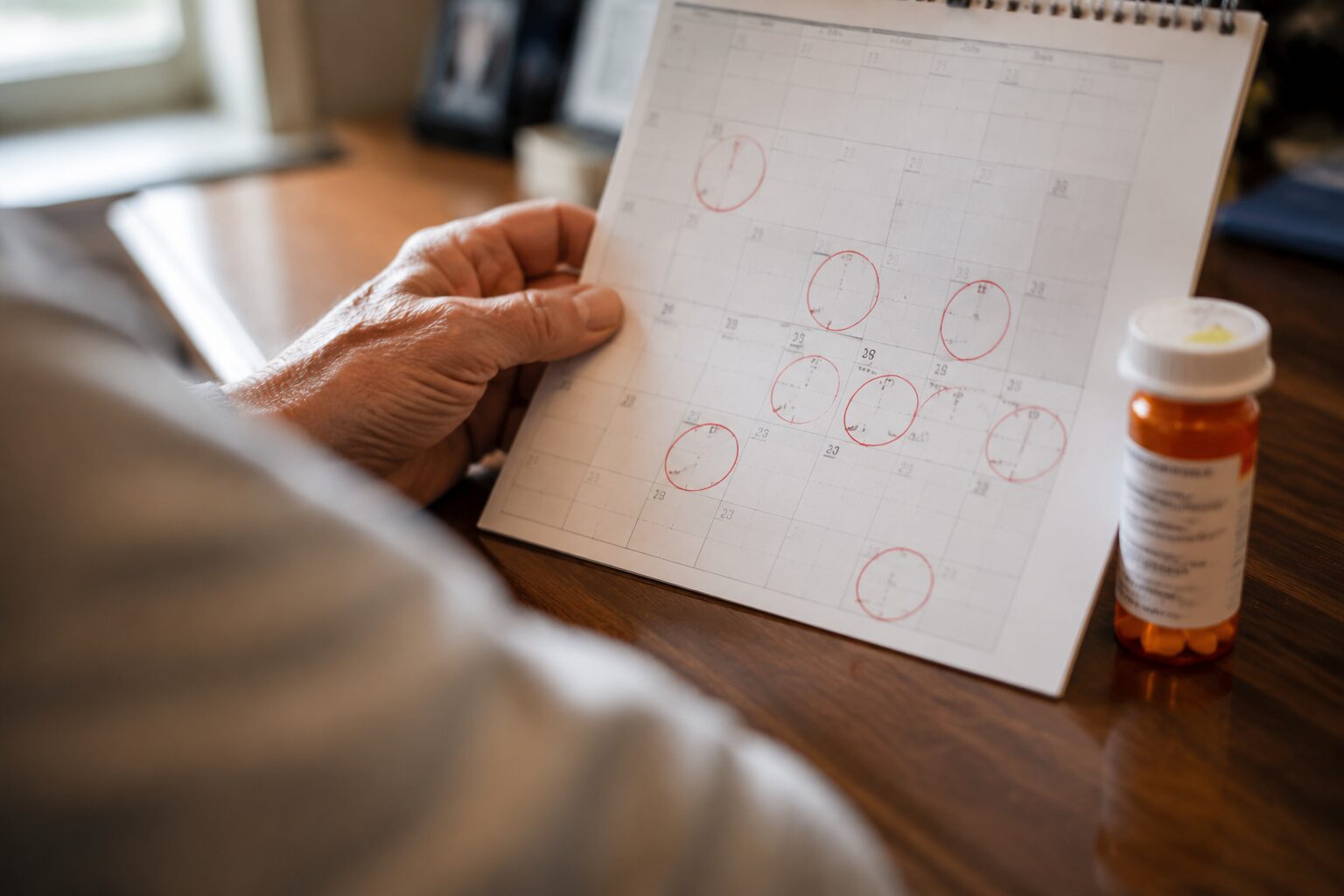
accutane prescription window timing
Last updated: June 11, 2026
I’ve coached people through complex systems with a lot of moving parts – quarterly OKRs, staged hiring pipelines, multi-phase product launches. But few systems trip people up as reliably as iPledge. Not because it’s complicated, exactly. Because the consequences of missing a step are immediate and the rules aren’t explained clearly upfront.
If you’re on Accutane or about to start, the single biggest risk to your treatment isn’t side effects or dosing. It’s running out of pills because you missed a timing window by a day or two. I’ve seen it happen more than once. The fix is always the same: understand the system before it bites you.
This article maps out the exact timing rules – the 30-day visit window, the 7-day pickup window, lab sequencing, and what to do if you miss a step. Read it once before your next appointment and you’ll have a system that actually protects your treatment.
Quick answer: Accutane prescriptions must be filled within 7 days of the prescriber’s authorization, and that authorization is only valid after a confirmed negative pregnancy test and an office visit within the prior 30 days. Missing either window requires restarting the visit-and-lab sequence before a new prescription can be issued.
Why Accutane Has Strict Timing Rules in the First Place
Isotretinoin is one of the most effective acne treatments available, and it also carries one of the most serious risks in all of outpatient medicine: it causes severe birth defects if taken during pregnancy. The FDA built a mandatory monitoring program around this drug specifically because of that risk.
That program is called iPledge. Every prescriber, every pharmacy, and every patient in the U.S. who touches isotretinoin has to be enrolled. The FDA requires monthly check-ins because isotretinoin clears your system quickly – a pregnancy test from 6 weeks ago tells your doctor nothing useful about today.
The rules feel like red tape until you understand what they’re tracking. Once that clicks, the system makes sense as something you can work with. One thing worth knowing early: iPledge treats patients differently depending on whether they can become pregnant.
If you can, you’re subject to a monthly visit window and a tighter 7-day pickup window tied to a pregnancy test. If you cannot, the rules are simpler – just the monthly visit window.
Both paths are manageable once you know which one applies to you.
The Two Timing Windows You Actually Have to Track
Most prescription delays happen because patients are tracking one window when they should be tracking two – or they don’t realize the clocks start on different days.
The table below lays out exactly what each window is, who it applies to, and what resets it.
| Window Type | Who It Applies To | What Starts the Clock | Allowed Range | What Resets It |
|---|---|---|---|---|
| 30-Day Office Visit Window | All patients | Your previous office visit date | 25-35 days after that visit | Missing outside the 25-35 day range; restart the count |
| 7-Day Prescription Pickup Window | Patients who can become pregnant | Day 1 = the day of your pregnancy test (included in blood draw) | Must pick up within 7 calendar days of that test | Missing the 7-day window; a new pregnancy test is required before the pharmacy can dispense |
| 30-Day Visit Window (simplified) | Patients who cannot become pregnant | Previous office visit date | 30 days from that visit; no secondary pickup countdown | Missing outside the allowed range requires rescheduling |
For patients who can become pregnant, Village Dermatology Houston confirms that Day 1 of your pickup window is the pregnancy test day itself – not the day you call the pharmacy or the day your doctor submits the authorization. You have 7 calendar days from that test to walk out of the pharmacy with your prescription.
For patients who cannot become pregnant, Rixis Dermatology confirms the process is more straightforward: your 30-day window runs from your office visit date, and there’s no secondary 7-day pickup countdown layered on top.
The most common reset trigger is waiting too long between the pregnancy test and the pharmacy. If you test on a Monday, your window closes Sunday night. Build in at least 1 buffer day in case the pharmacy has a stock issue or iPledge has a processing lag.
Month-by-Month: How the Visit and Lab Sequence Actually Works
The sequence is the same every month. What I tell people I work with: treat this like a recurring project with fixed deadlines, not a flexible appointment you can shuffle around.
According to Bella Cara Dermatology, labs must be drawn 25-35 days apart, with the office visit occurring approximately 2 days after the draw. Here’s the full sequence:
-
Schedule your lab draw between Day 25 and Day 35 – Count from your last office visit date, not your last lab date. Day 25 is the earliest iPledge will accept results; Day 35 is the hard cutoff. Drawing on Day 28 or 29 gives you a comfortable buffer on both ends.
-
For patients who can become pregnant – note the exact test date – Your pregnancy test is included in the standard blood draw. The calendar date of that draw is Day 1 of your 7-day pickup window. Write it down or screenshot the lab receipt. This date matters more than the visit date for pharmacy timing.
-
Attend your office visit approximately 2 days after labs – Your dermatologist reviews results at this visit and enters the prescription authorization into the iPledge system. No visit means no authorization. Missing this step stops everything downstream.
-
Confirm your dermatologist has authorized in iPledge – Authorization doesn’t happen automatically on the day of your visit. Ask before you leave: “Has the iPledge authorization been submitted?” Most offices do it same-day, but it’s worth confirming so you’re not standing at the pharmacy counter waiting.
-
Pick up your prescription within the correct window – For pregnancy-capable patients, that’s within 7 days of your blood draw. For all other patients, you have until Day 30 from your office visit. Don’t assume you have more time than you do.
-
Book your next appointment before leaving the office – Schedule it on the spot, 28-30 days out. This is the step most people skip, and it’s the one that causes them to drift past Day 35 the following month.
Set phone reminders at Day 20 and Day 25. Day 20 is your “schedule now if you haven’t” alert. Day 25 is your “labs must happen this week” alert. Two reminders costs you 30 seconds and protects a 4-to-6-month isotretinoin treatment timeline and phases. Understanding how long Accutane treatment takes and what affects duration can help you stay motivated through the monthly discipline.
What Happens When You Miss the Window
Missing a window doesn’t end your treatment. But it does create real friction, and the further outside the window you land, the more work recovery takes.
Here’s what actually happens at each failure point:
-
Labs drawn after Day 35 – iPledge flags the gap and the 30-day cycle resets. You cannot pick up a prescription until you restart the sequence from a new visit date. This typically adds 1-2 weeks to your timeline.
-
Prescription not picked up within 7 days (pregnancy-capable patients) – The pharmacy authorization expires. Your dermatologist has to re-enter the prescription in iPledge before the pharmacy can dispense. This is a same-day fixable problem if you catch it fast.
-
Missed office visit entirely – As DermWellesley notes directly, “missing an appointment may result in a significant delay in your treatment” due to the strict 30-day prescription window. A missed visit means no new authorization, full stop.
-
Running out of pills mid-course – This is the real risk. Most patients don’t stockpile, so a 4-day delay means 4 days without medication. For a detailed weekly Accutane progress timeline, consistency matters.
-
The path back – Call the dermatology office the same day you realize you’ve missed a window. Same-day calls give the office time to work within iPledge’s system. Waiting 48 hours narrows your options.
-
How far outside the window determines recovery time – One day past Day 35 is different from one week past. Same-day contact with your office resolves most single-day misses within 48-72 hours.
Most patients who miss once recover with a single phone call. The mistake to avoid is doing nothing and hoping it resolves itself.
A Real Patient’s Scheduling Mistake – and the Fix That Saved the Month
Accutane Prescription Window Timing: Questions Worth Answering Before You Start
Understanding how long Accutane treatment actually takes makes the monthly timing discipline feel more worth it. You can also review the Accutane treatment regimen, timing phases, and results to see how each month builds on the last. These are the questions I hear most often once patients understand the basic structure.
What if my 7-day pickup window falls over a holiday weekend and the pharmacy is closed?
The 7-day window runs on calendar days, not business days. Holidays don’t pause it. If a holiday weekend is coming up, pick up your prescription on Day 1 or Day 2 of the window instead of waiting.
You can also ask your dermatologist to schedule your blood draw earlier in the week so the window opens before the holiday, not during it.
Can I get my labs drawn early – say on Day 22 or 23 – to give myself more buffer?
No. Labs drawn before Day 25 fall outside the allowed window and iPledge will not accept them. Day 25 is the absolute earliest you can draw. If you’re anxious about timing, Day 25 or 26 is your best early option – it still satisfies iPledge and gives you 9-10 days before the Day 35 hard cutoff.
Does “Day 1” of the 7-day pickup window mean the day of the blood draw or the day of the office visit?
Day 1 is the day of your pregnancy test, which is included in your blood draw. The office visit typically happens 1-2 days after that, which still leaves you 5-6 days to pick up the prescription. The confusion here is common because patients assume the clock starts at the appointment – it doesn’t. It starts at the lab.
I’m traveling internationally during Month 4. Can I get a 60-day supply to cover the gap?
iPledge only authorizes a 30-day supply at a time, with no exceptions for travel.
Your options are: time your trip so you return within your pickup window, find a U.S.-licensed dermatologist in another city who can manage that month’s visit, or pause treatment temporarily and restart after you’re back.
Pausing adds time to your overall course, so plan around the window if you can.
Sources
- Rixis Dermatology – 30-day window rules for patients who cannot become pregnant
- Bella Cara Dermatology – Lab draw timing (25-35 day range) and 2-day visit sequence
- DermWellesley – Consequences of missing the 30-day prescription window
- Village Dermatology Houston – Day 1 pregnancy test timing and 7-day pickup window
- Serv-U Pharmacy – Accutane treatment regimen, phases, and course duration